Writing the Breakout Novel by Donald Maass
I cannot say enough about this book. If you are beyond the point of understanding GMC, then run, SPEED to your nearest bookstore and BUY THIS BOOK! It is fabulous. It covers everything - Premise, Stakes, Time and Place, Characters, Plot, Contemporary Plot Techniques, Multiple Viewpoints, Theme, etc.
Topic from book of the day - What Makes a Character Larger than Life?
Maas list these reasons and explains them in detail: Strength, Inner Conflict, Self-Regard, & Wit & Spontaneity. All valid characteristics of book heroines we admire. But he also takes it to a higher level with these words:
"....I would like to suggest that there are two character qualities that leave a deeper, more lasting and powerful impression of a character than any other: forgiveness and self-sacrifice."
Wow! When I read this years ago it was like I had been hit by a lighting bolt. Of course, those two items would make for a great heroine. It's hard not to like someone who is sacrificing for others without consideration of themselves. Look at the soldiers overseas, sacrificing their time with their families and sometimes their lives so that you and I can rest with our own families under freedom every night. Look at the fireman and policemen who rushed into the Twin Towers to rescue people, many losing their own lives in the process.
Now, I'm not saying your heroine needs to rush into a burning building or pick up a weapon and engage the enemy (although either of those is fine and I'd probably like to read it), but ask yourself in your current work - how can I make my heroine give up something important for the benefit of another?
My only caveat - and this is totally me, not Maass - make the recipient of the action worthy. If you have the heroine sacrifice for a total butthead, then some readers (definitely me) will think she's being foolish.
So what has your heroine done for others lately??????
Tuesday, May 23, 2006

Monday, May 22, 2006
My Writing Library
I get a lot of requests from newbie writers for reference material. So I thought I'd do something a little different this week and cover some of the books that are in my library and a bit about what each covers. I just grabbed the first one off the shelf this morning (I was in a hurry to get to work) and this is what I came up with for today:
The 38 Most Common Fiction Writing Mistakes by Jack Bickham
For those of you not in the know, Jack Bickham is also the author of Scene & Structure, the absolute bible of novel structures and explanation of scene & sequel - but we'll cover that later. Anyway, the point is, this guy knows what he's talking about. Sometimes people are put off by his phrasing, so I'm warning you now - he's not being condescending - he's a college professor and tends to write in pure academia language. It's not personal people.
38 covers tons of ground, from reasons to start and stay started all the way up to relationships with your editor.
Some of the chapters include: Don't Make Excuses, Don't Consider Yourself Too Smart, Don't Describe Sunsets, Don't Duck Trouble, Don't Lecture Your Reader, Don't Mangle Characters' Speech, Don't Forget Sense Impressions, Don't Worry About Being Obvious, Don't Give Up and many more.
The chapter I wanted to talk about a little bit more today is Don't Ignore Professional Advice. God, if I had a nickel for every time someone has received excellent advice from a published author and blatantly ignored it, well......back to that whole Dooney & Bourke comment from the last blog.
So let's assume you're in need of some advice - it could be on technique, time management, industry, marketing - whatever. You haven't found the answer in a book or in 1000 hours of online searching, so your next step is to ask someone. If you're really fortunate, you have a local writer's chapter with many published members. If not, you can always find published authors online. I am going to assume that you would NEVER ask an important question of an author you don't respect or admire, so we're going to also assume this person is competent in the field of writing for publication.
Then why on earth would you completely ignore everything they say????
Now, realize, I'm not about to imply that one writer can tell another exactly how everything should be done. But people who are doing it well enough to sell have obviously made things work. I believe the problem is many people talk to published authors and don't like the answer they get so they choose to ignore it altogether. What a waste. Please be open minded enough to consider the source, the viewpoint they are coming from and decide if what they are saying applies to you or is a fit for your situation. Maybe you ultimately decide it's not. Then pick another author with a closer fit for your genre/style, etc and ask again.
And please remember, just like in critiquing or rejection letters, if two or more knowledgable people are saying the same thing - there's usually a problem.
Don't let your ego or rose-colored glasses get in the way of your own progress.
Thursday, May 18, 2006
Write What You Know?
As writers, we have probably heard the expression "write what you know" at least a million times. Okay, maybe a million and two. And I'm sure most everyone past their first wip or who has attended at least one local RWA chapter meeting understands the concept. I'm an accountant, but that doesn't mean I need to write boring dribble about number-crunching for the evil corporate giant. What it means is I need to take my feelings, my thoughts, my emotions about things and apply them to the characters in my books. It's what makes them human.
I recently found a copy of No Plot? No Problem! in my local Half Price and snatched it up as I had heard it mentioned before by different successful authors. I am really enjoying the author's voice and what he has to say. The author is Chris Baty and for those of you who don't know, he's the brainchild behind NaNoWriMo (National Novel Writers Month). There is one sentence in the book that caught my attention more than "wwyk" ever did and that's
"If you won't enjoy reading it, you won't enjoy writing it."
Wow! Simple, direct, truthful. Yet how many times have we heard authors say they're going to try writing ______ next because that's the current hot seller? If I had a dollar for every time I heard someone utter this phrase and I went on to find out that they'd never actually read a book of that genre, well, let's just say me and Dooney & Bourke would both be very happy.
I've met mystery writers who've never read a mystery and can't even follow a conversation with the word "cozy" in it. They don't know what a police procedural is and couldn't tell me if they're writing one. And the list of people attempting to sell a romance because they're "easier" to sell/write/plot/market than other books is simply long and sad. They're the same people that think adding sex to any story makes it a romance. Uh, hello? Since when did we become men and equate hot sex to love?
Maybe a better rule would just be "write what you read." That way you're guaranteed at least one fan.
Monday, May 15, 2006
Pancakes in Peace
FINALLY! I found a new breakfast place!!!! The food is great and I won't go bankrupt buying it, the service is practically invisible but my coffee never runs out.
The atmosphere is very comfortable - metal chairs, vinyl booths and covered tables. And most important - normal patrons.
At the "other" place, everyone eating seemed to be in some sort of meeting and definitely had an agenda. This would have been fine except that they all talked too loud and the conversations were never interesting. Basically, there were only two kinds of patrons - the businessmen and the churchgoers.
The businessmen were annoying because they spent all their time talking about how their (fill in blank with any item for sale) was the best (item) served in the state of Texas and they were sure of it because their wife had said so.
The churchgoers were annoying (and somewhat circumspect) because they consisted almost completely of groups of men whose religious discussions always seemed to center around how to make their wives obedient. I nicknamed them "The Stepford Christians."
The new place - so far, no businessmen, no Stepford Christians - at least not that I've overheard.
I did, however, overhear a very interesting conversation at a table of retired farmers, where one of them had apparently been offended by the offer (for $20) of a professional to mow his yard where there was a steep incline. He had refused and set out to do it himself. What he managed to do instead was stall his mower, then get it stuck in neutral, and roll backwards down the incline and into the lake. It cost his $100 to fix the mower and $150 for a new cell phone since it was in his pocket when he took a dip and apparently didn't think to jump off before hitting water.
Ah, there's no place like home.
Subscribe to:
Posts (Atom)
Musings of a Louisiana Liar
Everyone knows what "they" say about opinions, but we all have one anyway so why not publish it - right? Welcome to my somewhat limited and sarcastic view of the world.
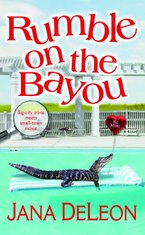
Coming October 30, 2007

UNLUCKY
My debut!
RT Book Reviews TOP PICK!